Current Real Progress and Controversies of the "Sustainable Tobacco" Concept
In the fall of 2024, I spread two documents across the same screen: one was a newly released Integrated Report from a multinational tobacco company, its cover decorated with lush greenery and clean tobacco fields; the other was a comparative material on ESG claims compiled by a civil tobacco control network, with a title so blunt it bordered on harsh—From Report to Reality. That same week, I also opened an environmental impact notice previously published by the WHO: an estimated annual toll of about 6 billion trees, 200,000 hectares of land, 22 billion tons of water, 84 million tons of CO₂, and over 8 million tobacco-related deaths. The three texts spoke of the same industrial chain, yet reading them felt like three parallel universes.
The four words "sustainable tobacco" have appeared frequently in recent years across procurement standards, agronomy training manuals, capital market roadshows, and brand PR releases. It sounds like a controversial crop has been given a ticket to the modern era. The question is: what has this concept actually improved? And what has it deliberately avoided?
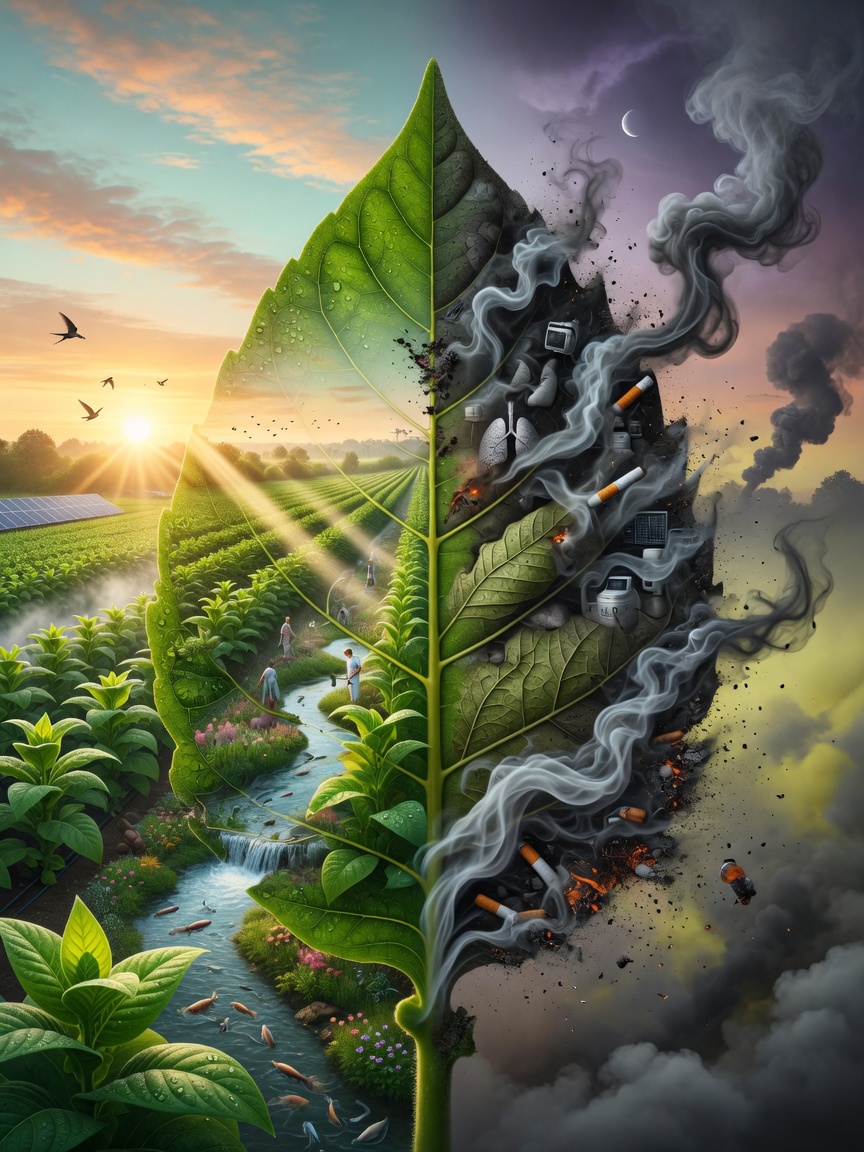
I. What Does "Sustainable Tobacco" Actually Refer To?
First, let's break down the term, otherwise the discussion will immediately slide into emotion.
In the industry context, sustainable tobacco usually stacks several layers of meaning:
It **typically does not refer to**—and cannot refer to—"greening" the health hazards of combustible cigarettes or nicotine addiction products. The core externality of tobacco as a commodity is disease and death, not how many cubic meters less of water a field of tobacco uses. Packaging partial improvements at the cultivation stage as a moral upgrade for the entire industry—this is where the controversy erupts.
My own working definition of this term is: **a set of management language that makes marginal reductions to measurable environmental and labor externalities while continuing to produce tobacco products.** It is operational improvement, not fundamental transformation—unless the company actually shifts its revenue structure away from combustible tobacco on a large scale and withstands independent verification.
II. The Industry Side Is Indeed Moving: Not Zero Progress
If we only repeat "tobacco = evil," we miss a fact: over the past decade, large buyers have indeed pushed a number of implementable projects in tobacco-growing regions. Denying every drop of water and every tree in these projects is not honest.
Water resources.** In 2025 public materials, PMI, together with local affiliates, leaf suppliers, and NGOs, promoted farm pond rainwater harvesting irrigation in the drought-prone region of Andhra Pradesh, India: storing seasonal rainfall as micro-reservoirs, combined with field training, to alleviate water competition between tobacco and food crops. The Leaf Sustainabilityofficial emphasized in a case study that without pre-planned water storage and usage planning under highly seasonal rainfall patterns, community conflict would intensify during dry periods. This is not empty PPT talk—farm ponds are a common small-scale water infrastructure form in South Asia, and tobacco companies embedding it into supply chain coaching is a replicable agronomic intervention.
Earlier data showed that PMI disclosed a roughly 24% reduction in tobacco-related water consumption from 2010–2015 through GAP (target 20%), along with phased reductions in global operational water consumption using 2010 as a baseline. Whether the figures cover all contract farmers and whether the scope is limited to the "company's controllable boundary" needs further discussion; but **directionally**, water conservation and drought resistance have indeed entered the buyer's agenda.
Agronomy and deforestation pressure.** Tobacco curing has long relied on biomass fuels, linked in parts of Africa and Asia to firewood harvesting. The industry's public response is: promoting more efficient curing barns, alternative fuels, and sustainable firewood management, while downplaying or denying the simplified accusation that "tobacco cultivation is the main cause of deforestation." Reviews such as *Tobacco in Australia* point out that the industry tends to **underestimate** tobacco cultivation's contribution to deforestation while loudly promoting "sustainable leaf production." Both sides hold partial truths—deforestation intensity can technically be reduced, but structurally tobacco still occupies arable land and rural labor.
Labor and supply chain frameworks.** Codes such as ALP write "no child labor, standardized contracts, field safety" into procurement conditions; STSC narrows the focus to the "lifecycle of tobacco leaves actually purchased by the company." For buyers, this is risk management: one media exposure of child labor in the fields immediately triggers ESG rating and regulatory trouble. For farmers, it may mean training and input support, or it may mean stricter compliance costs without rising purchase prices—I have heard contract farmers complain in industry exchanges: more inspections, but the purchase price list seems frozen in place.
Smoke-free product narrative.** PMI and other companies bundle "sustainability" with "smoke-free": public goals have included shifting tens of millions of people who would have smoked combustible cigarettes to smoke-free products. This is a commercial strategy and a reputational strategy. It responds to investor and regulatory pressure regarding the "endgame of combustible tobacco," not to shutting down the nicotine market.
These developments can be summarized in one sentence: **Under the constraint of "still growing tobacco, still selling tobacco," leading companies have internalized some environmental and social risks.** The work of engineers, agronomists, and supply chain compliance officers is real; calling their work purely performative is lazy.
III. The Criticism Side Is Likewise Hard-Hitting: Not Moral Purity
The other side's voices are equally substantive.
Health externalities override everything.** The core position of the WHO and the FCTC system is simple: the tobacco epidemic is a public health crisis. A January 2024 WHO notification showed that while global tobacco use continues to decline, relative to the 2010 baseline, it will only achieve about a 25% relative reduction by 2025, **falling short** of the voluntary target of 30%. Subsequent scenario analyses also indicate that on current policy paths, many countries and regions will struggle to meet the target on time. The industry talks sustainable agriculture while lobbying in policy arenas, interfering with taxation and flavor restrictions—the American Lung Association's *State of Tobacco Control 2025* and similar materials use extensive state-level legislative and lobbying registration data to describe the pattern of "slowing tobacco control policies for profit." When you overlay these two pictures, "sustainable tobacco" is easily read as: **using upstream greening to cover the social license of downstream addiction businesses.
The magnitude of environmental impact.** Around 2022, the WHO issued an alert on tobacco's environmental impact, providing global-scale estimates of trees, land, water, and carbon emissions. From a lifecycle perspective, the water footprint of a single cigarette from cultivation to consumption is estimated at several liters (different studies vary, but a common reference is about 3.7 liters per cigarette). Academic work also highlights the tobacco product sector's prominence in greenhouse gas emissions, non-agricultural blue water consumption, and permanent arable land occupation. A 20% reduction in water use on the cultivation side is progress, but **relative to the entire product lifecycle and health damage**, it is like wiping the deck of a leaking oil tanker.
Greenwashing accusations.** The WHO and multiple tobacco control organizations explicitly use the term greenwashing: a high-profile sustainability narrative while essentially expanding or maintaining the market for harmful products. The UN system's general definition of greenwashing also applies—making the public believe an entity is doing more environmentally than it actually is, thereby delaying real action. A March 2025 publication by the South African National Council Against Smoking and others specifically compared BAT and PMI's ESG claims from 2021–2023 with their business practices, questioning their SDG contribution narrative. Developmental studies-related commentary from the University of Bath directly criticized Big Tobacco's "appropriation" of the UN Sustainable Development Goals.
Exclusion logic on the investment side.** In responsible investment practice, tobacco and controversial weapons are often subject to hard exclusion: the evidence of harm is clear and difficult to "neutralize" through operational improvements. Asset managers such as Robeco placed tobacco on their exclusion list years ago, citing social costs and long-term mortality burden. In ESG index methodologies such as MSCI, ESG controversy and industry screening also place tobacco in a special category. The market votes with real money: you can improve curing barns, but you may never enter certain "sustainable" index constituents.
A brutal slice of field reality.** Sustainable agriculture research literature notes that biomarker detection rates for pesticide poisoning among some tobacco worker populations can be as high as roughly two-thirds of the sample (specific study samples need independent verification, but the direction indicates that chemical exposure and protection remain chronic problems). The "sustainable tobacco leaf" manual is filled with biological control and integrated pest management, but on-the-ground implementation depends on purchase prices, training frequency, and enforcement—all three of which are often lacking in low-income production areas.
The consolidated judgment from the criticism side is: **Sustainable tobacco is, at best, harm reduction management; at worst, a systematic reputational project.** Both can be true simultaneously, depending on which company's supply chain you are looking at, which year, and which third-party audit.
IV. How I Cross-Read, and Where I Get Stuck
From 2023 to 2025, I developed a crude method for comparative reading, and I've also stepped into pitfalls.
Step one: clarify the "boundary."** Corporate reports love to say "our tobacco leaves are 100% from GAP contract farmers." Ask: is GAP an internal standard or a third-party certification? Does it cover directly managed farms or layers of intermediaries and subcontractors? Are audits document spot-checks or surprise visits during peak farming season? I once saw "sustainable certification" wording in a supplier introduction; when I pressed for the certificate number and standard version, the response changed to "aligned with GAP principles"—two words difference, but a completely different level of legal and credibility weight.
Step two: align time and baseline.** "A 24% reduction in water consumption" must have a base year, geographic scope, and whether it includes irrigation and processing. Changing the base year or excluding high-risk production areas makes the curve look better. Carbon data is similar: Scope 1/2 is manageable; Scope 3 (especially agronomy and use stage) is most easily glossed over.
Step three: separate "agronomic KPI" from "product harm" into two ledgers.** How many cubic meters of water a farm pond stores is one ledger; daily cigarette sales and attributable disease burden is another ledger. Industry public relations likes to automatically transfer progress from the first ledger into the moral balance of the second ledger. I refuse this accounting.
Step four: look at policy behavior, not just CSR brochures.** In the same fiscal year, a company can publish a biodiversity commitment and also submit opinions unfavorable to tobacco control at a key tax hearing. The 2023 Global Tobacco Industry Interference Index and similar materials show that efforts to protect health policies from industry interference are deteriorating in many places. **The coexistence of sustainability narrative and policy interference is the split I find hardest to digest.
The three most common problems in practice:
These problems are not "anti-tobacco people finding fault"—they are hard constraints faced by any sustainable supply chain for a bulk agricultural commodity. Tobacco is simply magnified to ethical extremes because its product endpoint is addiction and disease.
V. The Structure of the Controversy: Four Unsolvable Knots
Knot one: wrong object.** When the public hears "sustainable tobacco," they easily imagine "healthier cigarettes." Linguistic pollution is real harm. A more accurate term would be "environmentally controlled tobacco leaf supply chain" or "labor-compliant tobacco leaf," rather than washing the entire tobacco industry as a sustainable commodity.
Knot two: relative improvement vs. absolute scale.** If the water footprint per kilogram of tobacco leaves decreases, but global or regional tobacco cultivation and sales volumes remain large, the total environmental load may not actually decrease. Harm reduction in public health discusses "individual exposure," but in environmental terms, it must address "total volume."
Knot three: the contest over SDGs.** The industry emphasizes responsible production, clean water, and decent work within the SDGs; the tobacco control community emphasizes SDG 3.a (strengthening FCTC) and health targets. Both sides cite the same global agenda and reach opposite conclusions. My view is: **health goals have lexical priority over tobacco**—without health, water conservation in the fields only polishes the coffin more brightly.
Knot four: whether smoke-free transformation counts as "sustainable."** If smoke-free products truly reduce population exposure and do not renormalize youth initiation, they may be superior to combustible cigarettes in public health terms; but they are still a nicotine business, and the environmental footprint (batteries, plastic cartridges, electronic waste) shifts to a different set of problems. Packaging heated tobacco as a climate solution is conceptual overreach.
VI. My Judgment: Progress Is Real, the Concept Is Overloaded, and the License Is Expensive
At this point, I don't need to pretend neutrality to the point of losing my position.
I believe the industry's partial improvements in cultivation and manufacturing are real and should be recorded.** Farm ponds, efficient curing barns, pesticide reduction, child labor prohibition clauses, and factory water and carbon management are obligations that any 21st-century bulk agricultural commodity buyer should fulfill. If done, they should not be cursed as "doing nothing"; if not done thoroughly, they should not be awarded a "sustainable hero" medal.
I believe that "sustainable tobacco" as a brand-level concept is currently severely overloaded.** It bundles compliant agronomy, ESG disclosures, smoke-free transformation, and social donations into a single moral buzzword used to offset fundamental product harm and policy resistance. In public discourse, the communicative effect of this term often exceeds its technical substance—that is the breeding ground for greenwashing risk, even if there are honest engineers behind specific projects.
My practical advice to three stakeholder groups is narrow:
If I had to score "sustainable tobacco" at its current stage: as a **supply chain risk management tool**, it scores from passable to good, depending on the company and region; as an **ethical and sustainable development narrative**, it fails—because it attempts to use manageable marginal indicators to buy social trust consumed by unmanageable core harms.
I will continue reading those integrated reports, and I will also continue reading the WHO and independent comparative studies. Not to take sides in a shouting match, but because the water, forest, and child labor issues in tobacco fields are real problems, and the lung cancer and heart attacks in cities are also real problems. Sewing two real problems into a single slick slogan does not solve either of them. What we can do is to disassemble the slogan back into indicators, and the indicators back into the fields, the courts, and the clinics—where both progress and controversy have nowhere to hide.
Major Public Information References (For Verification)
5. Tobacco control and civil society: ESG claim comparison reports targeting BAT/PMI (e.g., 2025 materials from the South African National Council Against Smoking, etc.); critiques of Big Tobacco and UN SDG narrative (University of Bath commentary, etc.); UN elaboration of the greenwashing concept.
6. Investment practice: Asset manager tobacco industry exclusion cases; mainstream ESG/climate index screening logic for controversial industries.
Industry Narrative
Emphasizes water conservation, pesticide reduction, sustainable firewood management, and smoke-free transformation at the cultivation stage
Criticism Narrative
Points out that health externalities override everything, total environmental load has not decreased, and greenwashing risks coexist with policy interference